“A Pakistan-Style Trap”: How Bangladesh’s Blasphemy Accusations Are Being Weaponised Against Hindu Minorities
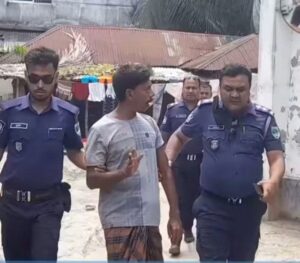
Police have arrested Prashanta Kumar. His alleged crime: making a derogatory remark about Islam — at a tea stall, overheard by a Muslim bystander while he sat among Hindu neighbours sharing a cup of tea.
No forensic evidence. No recording. No independent verification. Just one accusation — and handcuffs.
Anyone familiar with the history of religious persecution in South Asia will recognise this pattern instantly.
The Pakistan Blueprint, Replicated
For decades, Pakistan’s blasphemy laws have functioned not as instruments of justice, but as weapons of personal vendetta and communal dispossession. A business rival, a land dispute, a personal grievance — any of these could be resolved by accusing a Hindu neighbour of insulting Islam. No evidence was required. The accusation alone was enough to destroy a life. The consequence was demographic: today, Hindus in Pakistan have dwindled to less than one percent of the population. Hindu Voice
Bangladesh is now replicating this playbook with disturbing fidelity.
A Documented Pattern of Fabricated Accusations
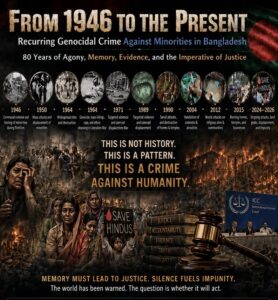
Prashanta Kumar’s case is not an isolated aberration. It is part of a widening crisis that human rights organisations have now documented in alarming detail.
At least 71 incidents linked to blasphemy allegations against Hindu minorities were reported in Bangladesh in just the six-month period from June to December 2025, documented across more than 30 districts by the Human Rights Congress for Bangladesh Minorities (HRCBM). India Tribune
Over the past decade, Bangladesh has witnessed a recurring pattern of targeted violence, legal intimidation, and social unrest linked to blasphemy allegations. Extremist elements have frequently leveraged fake claims to justify attacks on Hindu communities, often acting with impunity. In many instances, mobs carried out violent assaults before any investigation was completed, attacking individuals, families, temples, and entire neighbourhoods. Organiser
Human rights observers stress that the recurring pattern — social media accusations, rapid arrests, mob mobilisation, and targeting of Hindu localities — suggests blasphemy allegations are increasingly being used as a trigger for persecution, intimidation, and social exclusion. The report concludes that minors and economically vulnerable individuals are disproportionately affected. India Tribune
The cases are chilling in their breadth. A Hindu schoolteacher, Hriday Chandra Mondal, was arrested in Munshiganj after being accused of insulting the Prophet Muhammad and the Quran. Following his arrest, his family reported living in fear, with neighbours abusing them verbally, and his son unable to attend school. Vsktelangana Joy Sarkar, a 22-year-old Hindu youth, was arrested for writing on Facebook that “Sanatana Dharma is the oldest religion” — a comment deemed blasphemous. OpIndia
In November 2024, Prashanta Kumar Saha, a 25-year-old Hindu man from Pabna District, was accused of blasphemy. The following day, Islamist groups staged protest rallies at which Hindu shopkeepers were threatened and coerced into closing their businesses — even though Prashanta was reportedly residing in Dhaka at the time of the alleged incident. That night, a mob attacked a local Hindu temple, desecrating religious idols, while slogans including “Demolish the shelters of non-believers!” and “We demand the blasphemer be hanged!” were heard — reportedly led by local Jamaat-e-Islami figures present at the scene. Hindu Voice
When a Casual Remark Becomes a Death Sentence
The most devastating recent case exposed how these accusations can escalate to murder. On 18 December 2025, Dipu Chandra Das, a 27-year-old Hindu garment worker in Bhaluka, was falsely accused of making derogatory remarks about Islam during a casual conversation among co-workers. He was beaten, hanged from a tree, and set on fire. Investigators later reported that no evidence was found to support the original allegation. Wikipedia
What the 2026 wave of violence exposes is not merely communal hatred, but a sophisticated convergence of technology, ideology, and political manipulation. Victims are labelled online as “Indian agents” or foreign informers, their photos and addresses circulated in closed WhatsApp groups and public Facebook pages, normalising violence against them as an act of patriotic cleansing rather than a crime. Indiasentinels
The State’s Double Standard
Bangladesh’s interim government claims to uphold equal rights for all religions. The evidence on the ground tells a different story.
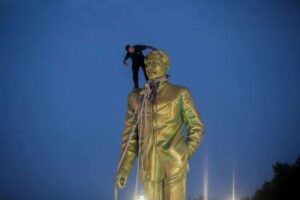
When a Hindu deity’s image was publicly desecrated — an act that drew protests from Bangladeshis and diaspora communities worldwide — not a single arrest was made. Yet when a Hindu man is accused of a casual remark overheard at a tea stall, police arrive swiftly.
When police move swiftly against alleged blasphemers rather than against those who spread fake posts, the state is not neutral — it is participating in the script. Indiasentinels
And when voices are raised in protest against this discrimination, the state’s response has been to silence them. Chinmoy Krishna Das, a Hindu monk and minority rights activist who had been protesting against the rising persecution of Hindus following the ousting of the Sheikh Hasina government, was arrested on sedition charges in November 2024 and spent five months in custody before being granted bail. Attempts to secure his release were repeatedly frustrated, with one hearing disrupted due to alleged threats against his lawyer. The Week
A Demographic Catastrophe in Slow Motion
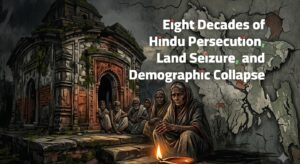
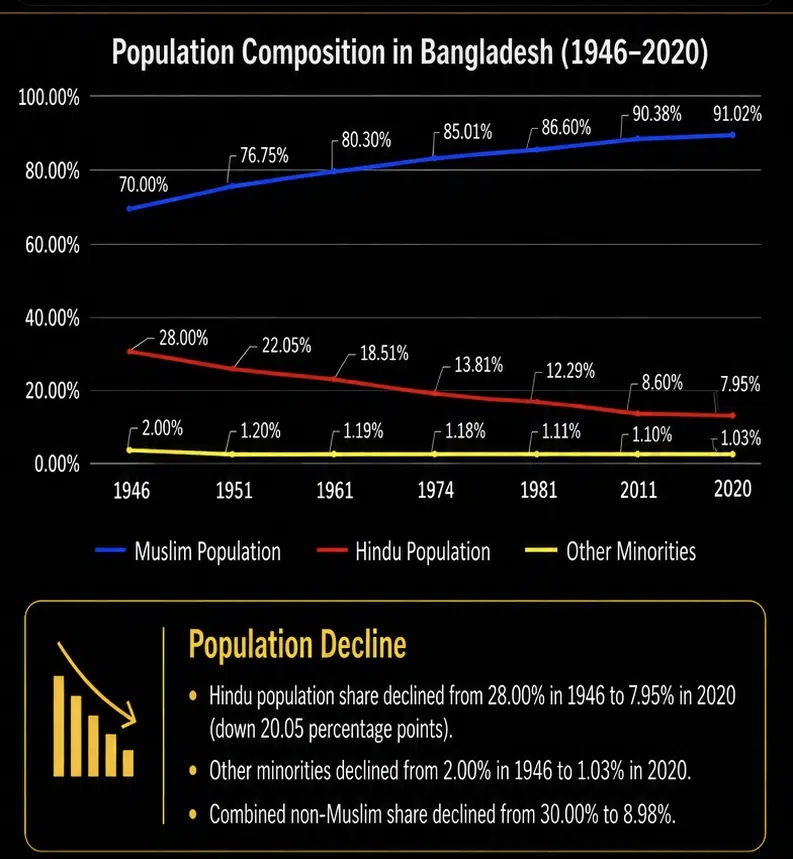
The historical trajectory is unambiguous. Where blasphemy law is weaponised against minorities with state acquiescence, those minorities disappear — not all at once, but steadily, across generations, through fear, dispossession, and exile.
Human rights groups have recorded thousands of incidents of vandalism, arson, and targeted violence against Hindus since 2013, underscoring how blasphemy incidents often mask more material motives of dispossession and intimidation. When, immediately after attacks, local strongmen move to occupy the shops, fields, and neighbourhoods left behind by fleeing families, blasphemy looks less like hurt faith and more like a tool of demographic engineering. Indiasentinels
Bangladesh’s founding ideals — secularism, pluralism, justice — are written into the spirit of the Liberation War of 1971. But Prashanta Kumar, arrested for a conversation over tea, is not living in that Bangladesh. He is living in a country where the law protects the accusation, not the accused — and where being Hindu is, increasingly, reason enough to be guilty.
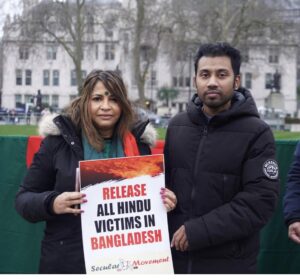
The author Nishit Sarker Mithu, a journalist, human rights activist, and organiser with the Secular Bangladesh Movement UK.