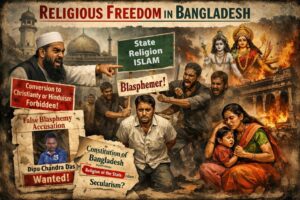
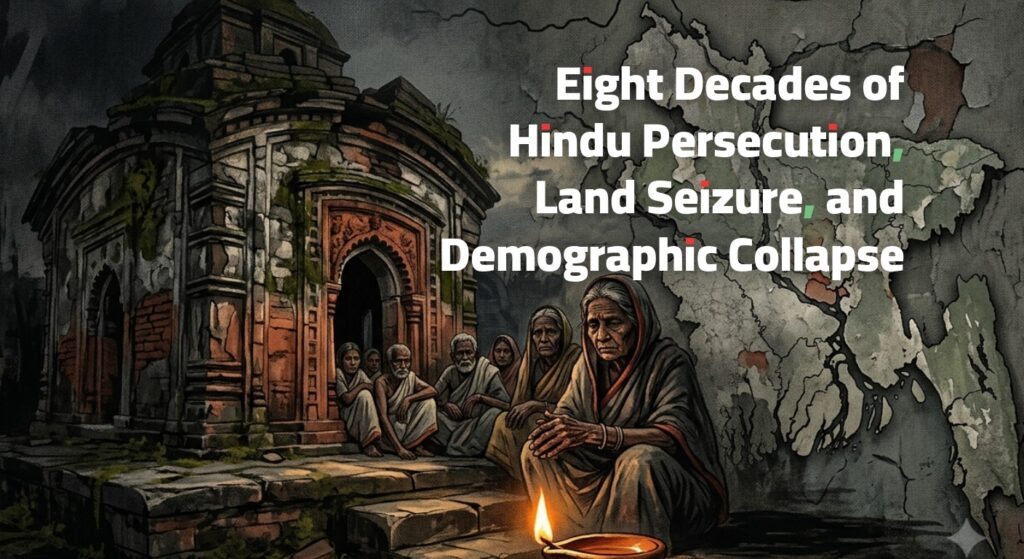
Bangladesh’s Hindu minority has fallen from 30% to under 8% since 1947. Discover the untold history of persecution, land seizure, and forced exodus.
A Ancient Land, A Shrinking People
Long before the arrival of Islam in the Bengal region, this land was home to one of the world’s oldest continuous civilisations. Archaeological evidence at Pandu Raja’s Mound dates back nearly 4,000 years. The Wari-Bateshwar civilisation in Narsingdi is approximately 2,500 years old. The Pundra civilisation and the legendary Gangaridai — recorded by Greek historians around 300 BCE — along with the Samatata and Harikela civilisations discovered at Mainamati in Comilla, all testify to the fact that Bengal was historically a Hindu and Buddhist heartland. There were no Muslims in this region until the arrival of Ikhtiyar Uddin Muhammad bin Bakhtiyar Khilji in the 13th century. Before him, Hindu and Buddhist kings ruled Bengal for over five centuries. This was their birthplace. They did not come from Delhi, Afghanistan, Iran, Turkey, or England to govern Bengal — they were its original people.
The Population Numbers Tell a Damning Story
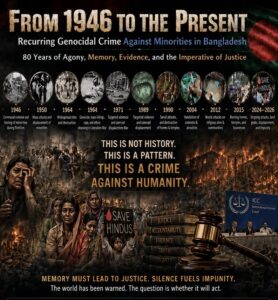
In 1941, the census recorded 11.8 million Hindus in what is now Bangladesh. By 1947, following the creation of Pakistan, Hindus constituted over 30 percent of the population. Today, that figure has collapsed to just 7.95 percent.
This is not natural demographic change. This is the result of deliberate, sustained, and systemic persecution spanning nearly eight decades.
1946: The Noakhali Massacre
The trajectory of violence against Bangladesh’s Hindus can be traced to the Noakhali genocide of 1946, instigated by the religious leader Golam Sarwar Hussaini and carried out by his militia, the Miyar Fauj. Hindus were killed indiscriminately, their properties looted, and thousands forcibly converted to Islam. British-era English newspapers reported approximately 5,000 deaths, with thousands more injured and subjected to sexual violence.
Following Partition in 1947, the persecution became institutionalised through law:
The communal riots of 1950 drove hundreds of thousands of Hindus out of East Pakistan. The Enemy Property Act of 1968 provided a legal framework for stripping Hindus of their land and property, accelerating mass displacement. The Vested Property Act continued this policy, enabling the seizure of Hindu-owned land and creating conditions of deliberate social marginalisation designed to push Hindus out of the country.
Between 1947 and 1951 alone, millions of Hindus were effectively forced to leave. The 22 percent Hindu population recorded in 1951 has since fallen to under 8 percent today.
1971: Genocide and Its Aftermath
During the Liberation War of 1971, more than two million Hindus were killed — targeted specifically on the basis of their faith by Pakistani forces and their local collaborators. Yet even after independence, the killing and dispossession continued. Following the assassination of Sheikh Mujibur Rahman in 1975, attacks on Hindus — including killings, forced displacement, and property seizures — became a recurring feature of Bangladeshi political culture, exploited by successive governments and their supporters.
A Double Standard in Plain Sight
There is a profound and troubling contradiction at the heart of Bangladeshi public discourse. The same sections of society that for generations have persecuted, dispossessed, and killed Hindus at home now march in solidarity with Palestinians and Syrians, invoking the language of human rights and Muslim brotherhood. Some have been seen publicly sloganeering in support of Pakistan — the very state responsible for killing 3 million Bangladeshis in 1971.
The Israeli Ambassador to India has publicly stated that Hamas-linked operatives are running networks inside Bangladesh — a deeply concerning allegation with significant regional security implications.
Meanwhile, the indigenous Buddhist communities of the Chittagong Hill Tracts have faced continuous bloodshed since 1947. They are threatened with expulsion to Myanmar. In the plains, Hindus have been told for 55 years to go to India if they want safety.
A Country Allergic to Itself
A significant segment of pro-Pakistan, Islamist-aligned Bangladeshis appears to reject the very foundations of the Bangladeshi state. They are hostile to the secular, pluralist constitution of 1972, born from the Liberation War. They object to the national anthem. They are uncomfortable with the national flag. They recoil from Bengali dress and cultural traditions. They do not celebrate the country’s songs. They oppose the peaceful coexistence of different religious communities.
These are not fringe attitudes. They represent a deeply embedded ideological current that has, for decades, worked to transform Bangladesh from a pluralist, secular state into an exclusionary religious one — at the direct expense of its Hindu, Buddhist, and Christian minorities.
When a nation systematically drives out its own indigenous population through law, violence, and social pressure — when the children of the oldest civilisations of Bengal are made strangers in the land their ancestors built — can that nation honestly claim to be civilised?
The Hindu population of Bangladesh has declined from nearly a third of the country to less than one in thirteen over the course of a single lifetime. This is not coincidence. It is a crisis demanding international attention, accountability, and action.
Nishit Sarker Mithu is a UK-based journalist, human rights activist, and organiser with the Secular Bangladesh Movement UK. He advocates for minority rights and accountability for 1971 war crimes.