A country that rewards its terrorists and abandons its martyrs of reason
Do you remember the series of blogger killings? The systematic murders of secular writers, Hindu priests, Christian activists, and freethinkers that made Bangladesh shudder? Beginning around 2009 and continuing for nearly seven to eight years, these targeted assassinations carved a trail of blood through the nation’s intellectual and minority communities.
Science writer Avijit Roy. Academic Dr. Humayun Azad. Blogger Ananta Bijoy Das. Blogger Niloy Neel. Hindu priests. Secular voices. One by one, they fell — machete by machete, knife by knife — silenced for the crime of thinking freely.
Their killers were caught. Tried. Convicted. Some received life sentences. And then — in what can only be described as a moral catastrophe — they were let go.
The Great Unburdening of Killers
Since Muhammad Yunus assumed power as Chief Adviser, a procession of convicted militants and self-proclaimed jihadists has walked out of Bangladesh’s prisons. Among those reportedly released or acquitted are:
Shafiul Rahman Farabi — self-declared jihadist, convicted in multiple blogger murder cases. Mufti Izhar ul Islam Chowdhury and Harun Izhar — senior militant figures, previously arrested in 2009 on charges of plotting attacks on the Indian High Commission and the United States Embassy in Chittagong, and linked to a grenade explosion at Lalkhan Bazar Madrasa in Chittagong on 10 July 2013. Jasimuddin Rahmani — ideological mentor to extremist networks. Mahfuzur Rahman, Abul Fattah, and numerous others — their names forming a grim roster of Bangladesh’s most dangerous convicted criminals.
According to reports circulating since August 2025, each acquittal has allegedly been accompanied by enormous financial transactions — some sources suggesting payments exceeding hundreds of crore taka per release. Whether or not the full extent of such allegations is proven, the pattern itself is impossible to ignore: men convicted of murdering freethinkers and targeting diplomats are now free men.
The Erasure of Victims’ Memory
The contempt for victims is not only structural — it is sometimes shockingly literal. On 29 August 2024, the memorial sculpture dedicated to the victims of the 2016 Holey Artisan Bakery attack — in which Islamic State-claimed gunmen massacred twenty-two people, mostly foreign nationals, in one of Dhaka’s most horrific terrorist atrocities — was vandalized and demolished in Dhaka. The monument that stood as a quiet tribute to innocent lives lost to jihadist violence was torn down, its destruction greeted with near-silence from those in power. It was a fitting, if grotesque, symbol of the current order’s priorities: erase the memory of terrorism’s victims while releasing terrorism’s perpetrators.
Harun Izhar and the Madrasa Bomb Factory
The story of Harun Izhar is instructive. Arrested in 2009 alongside two suspected Lashkar-e-Taiba operatives for allegedly plotting attacks on foreign diplomatic missions, he later came to prominence again during the April 2021 agitation surrounding Indian Prime Minister Narendra Modi’s Bangladesh visit. Harun Izhar allegedly led protests at Darul Ulum Hathazari and elsewhere, taking a publicly anti-government stance. He was arrested by RAB on the night of 28 April 2021 from the Lalkhan Bazar Madrasa in Chittagong.
He is now free.
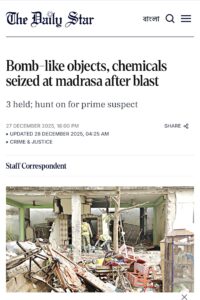
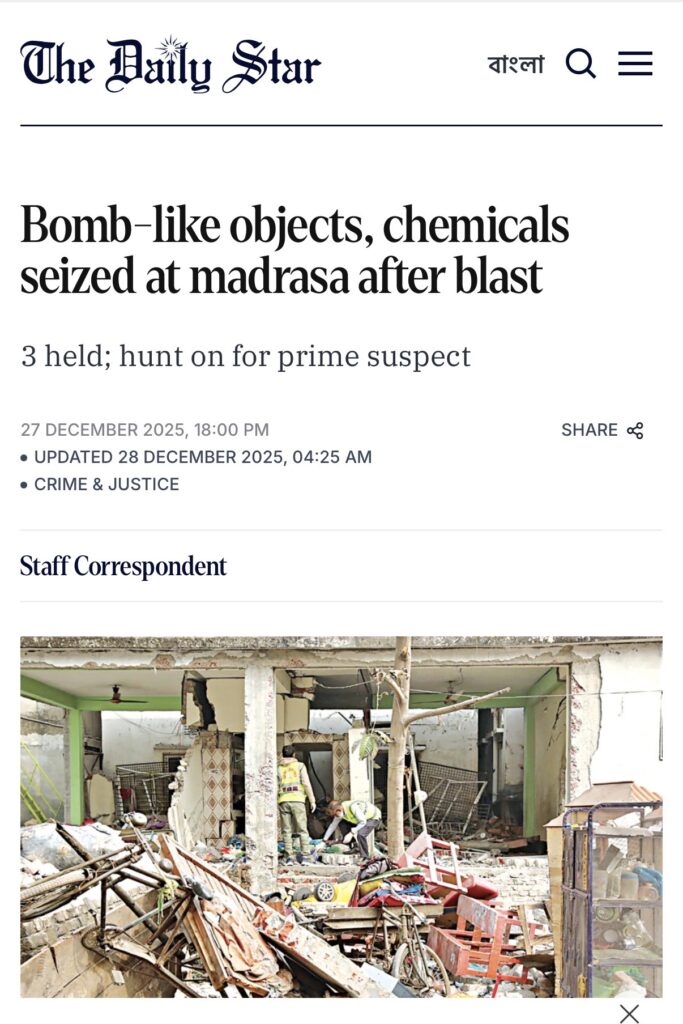
The connections do not end there. In late December 2025, a massive explosion at a madrasa in Keraniganj, Dhaka, caused an entire building to collapse. The madrasa was under the supervision of an individual who had himself been imprisoned during the previous government on terrorism charges — and subsequently released under the Yunus administration. His wife, Achia, is the sister of Mufti Harun Izhar. From the ruins of that madrasa, investigators reportedly recovered hundreds of kilograms of bomb-making materials.
Tarique Rahman’s Strange Alliances
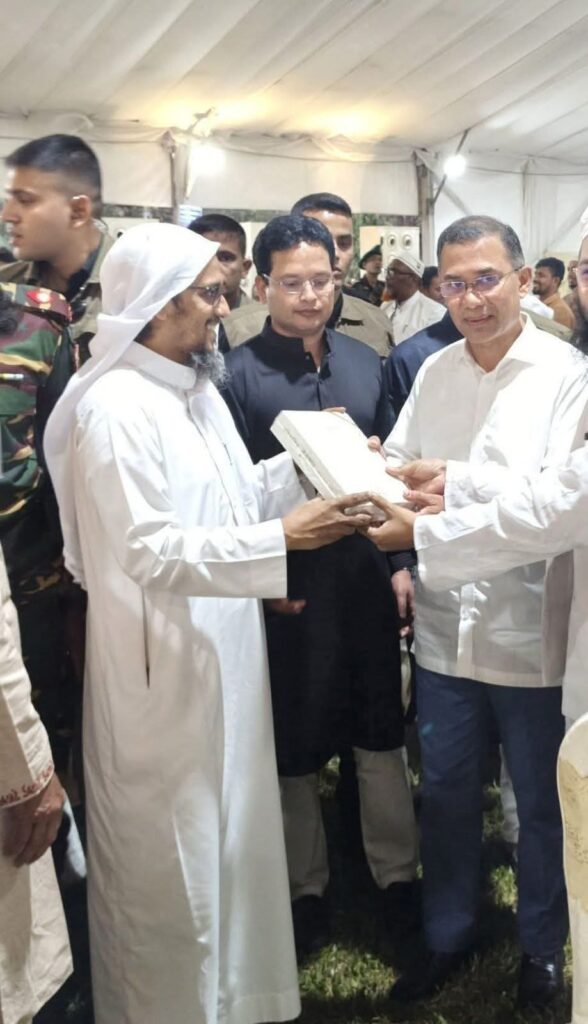
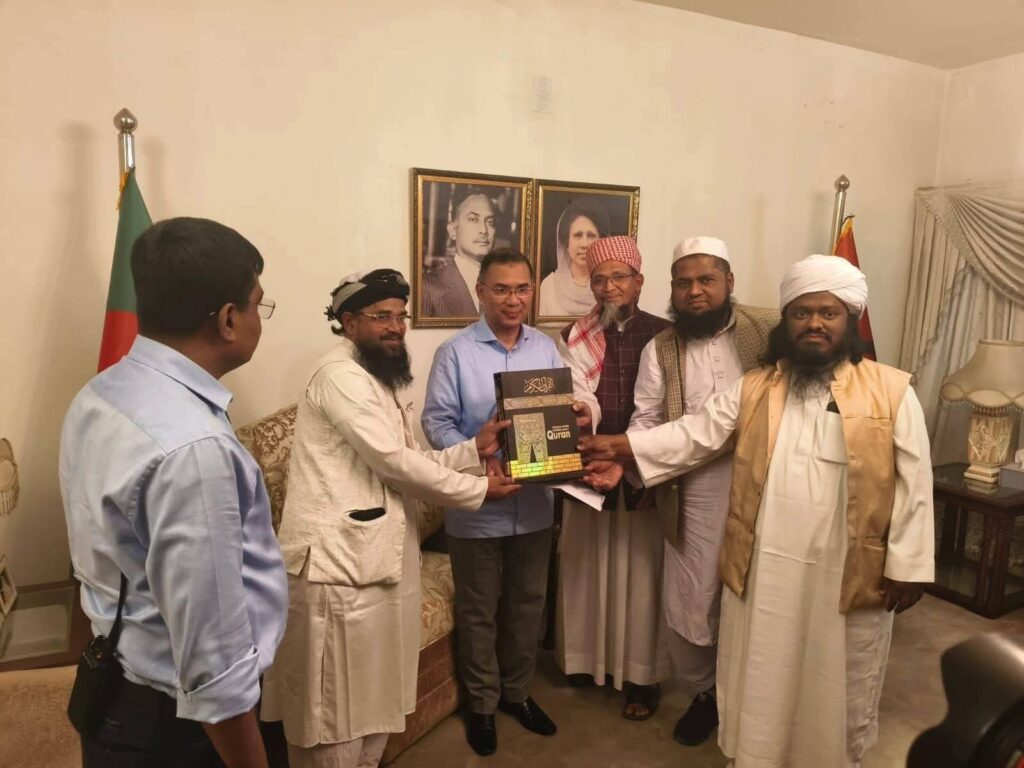
Tarique Rahman — son of former Prime Minister Khaleda Zia, himself convicted in absentia in the 21 August 2004 Dhaka grenade attack that killed over twenty people at an Awami League rally — has in recent times cultivated close relationships with figures such as Mufti Izhar ul Islam Chowdhury and Harun Izhar.
This is the same Tarique Rahman who, during his years as the prime minister’s son, ran the infamous Hawa Bhaban — a parallel power centre from which regular extortion was allegedly levied on institutions across the country.
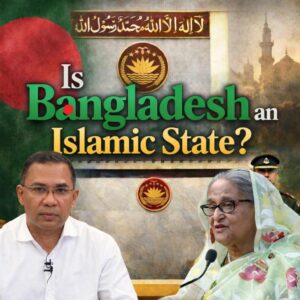
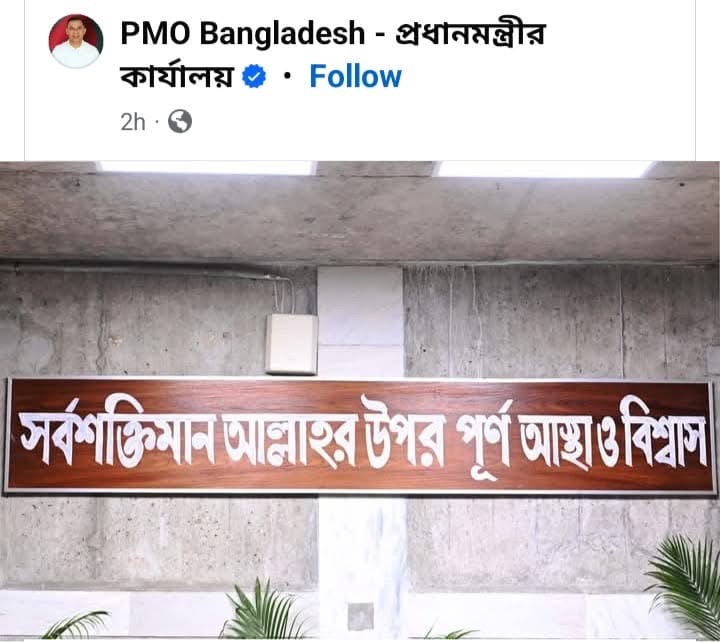
Today, he has overseen the placement of Islamic calligraphy bearing the Kalima and declarations of absolute faith in Allah in parliament and the cabinet chamber — a gesture that would be extraordinary even from an openly Islamist party holding state power.
More strikingly, the parliament under his party’s influence has passed condolence motions for leaders of Jamaat-e-Islami — the organisation whose leaders were convicted of crimes against humanity during the 1971 Liberation War, in which an estimated three million people were killed.
The Imprisoned and the Forgotten
While convicted killers receive their freedom, others languish without justice.
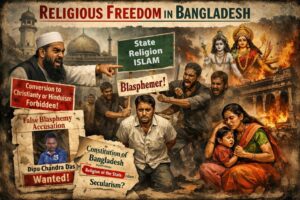
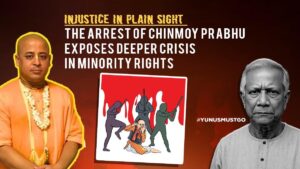
Chinmoy Krishna Das — a Hindu monk and prominent voice for minority rights — remains imprisoned. Human rights advocate Shahriar Kabir remains in detention. Dipu Chandra Das, whose case few have thought to raise publicly, receives barely a mention.
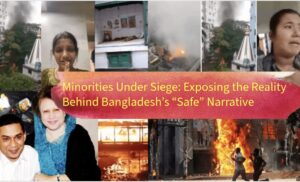
Every day, members of religious minorities are targeted in what can only be called targeted killings — quiet, brutal, and increasingly routine. Yet an administration that has embraced the very networks historically associated with such violence consistently categorises these incidents as isolated, ordinary crimes. When the state itself has made common cause with jihadists, when it cannot bring itself to name the pattern it is looking at, the silence of the administration becomes a kind of complicity.
What It All Adds Up To
The arithmetic of Bangladesh’s current moral order is not complicated, though it is deeply disturbing.
Those who killed scientists, bloggers, rationalists, priests — men and women who were building Bangladesh through knowledge, culture, and the courage of ideas — are rewarded with freedom, with money, with political friendship, and with the implicit protection of power.
Those who were killed receive nothing. No state commemoration. No act of parliament. No condolence motion.
And those who survive — the activists, the monks, the secular advocates — are put in prison.
Avijit Roy was hacked to death on a Dhaka street in February 2015, returning from a book fair. He had spent his life writing about science, humanism, and reason for Bengali readers around the world. His killer’s colleagues walk free today.
As the old Bengali lament goes — borrowed now with bitter irony — “Truly, Seleucus, what a strange country this is.”